
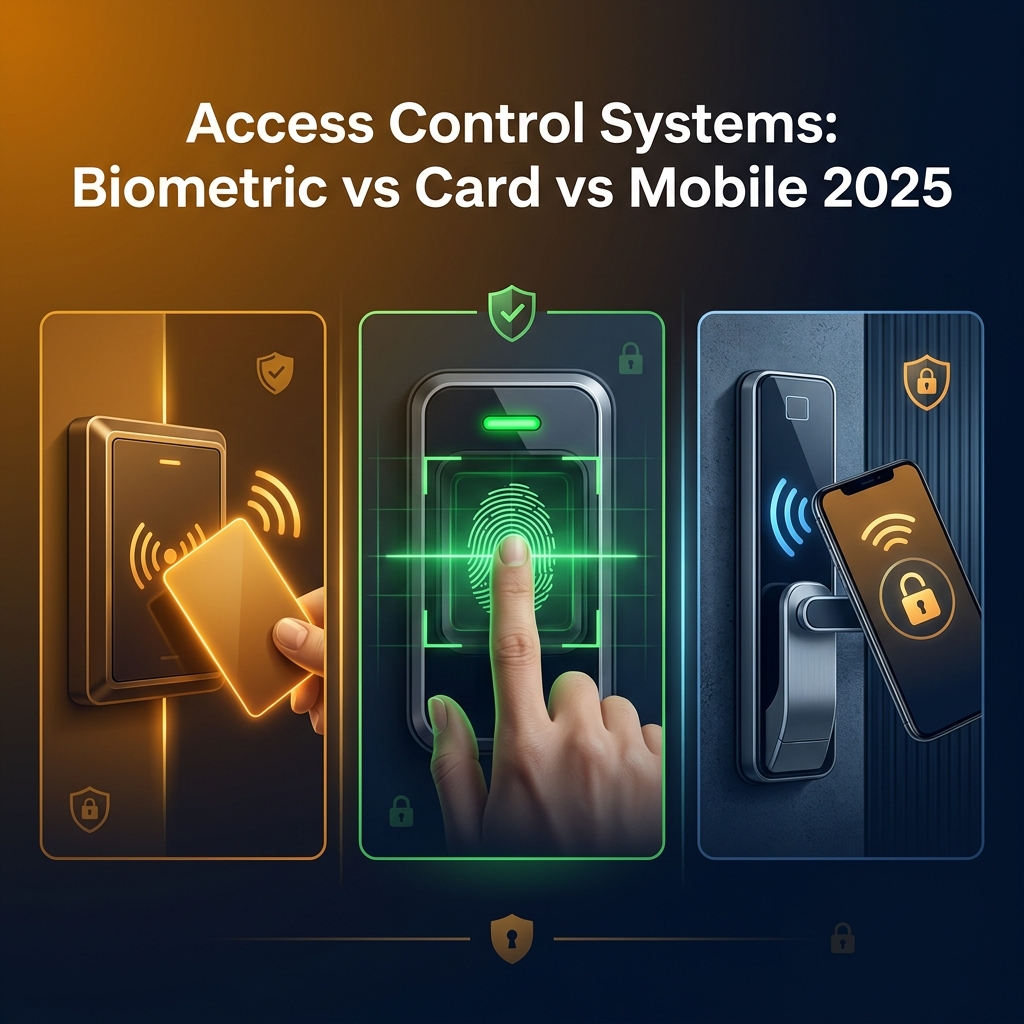
Access control has come a long way from the simple lock and key. Today, businesses can choose between card-based systems, biometric readers using fingerprints or facial recognition, and mobile credentials that turn an employee's smartphone into their access card. Each approach has distinct advantages, and the right choice often depends on the specific area being secured. Here is how they compare.
Card-Based Access Control
RFID or smart cards remain the most widely deployed access control credential, and for good reason. Cards are inexpensive, familiar to users, fast to issue and revoke, and well suited to high-traffic areas like main entrances and office floors. The main drawback is that cards can be lost, shared, or lent to someone else — meaning the system cannot guarantee that the person presenting the card is the person it was issued to.
Biometric Access Control
Fingerprint and facial recognition readers verify the identity of the person directly, eliminating the "lost or shared credential" problem entirely. Modern facial recognition terminals can also perform contactless temperature screening, which became popular for health-conscious facility management. Biometric systems are particularly well suited to high-security areas such as server rooms, NICUs, pharmacy stores, and cash handling areas where audit trails of exactly who entered are critical.
The trade-offs are higher per-door cost compared to card readers, and some employees may have privacy concerns about biometric data — which should be addressed with clear policies on how the data is stored and used.
Mobile Credential Access Control
Mobile access uses an employee's smartphone — via Bluetooth or NFC — as their credential. Credentials can be issued and revoked instantly and remotely, which is particularly useful for organisations with high staff turnover, contractors, or multiple sites managed centrally. Since most employees already carry their phone everywhere, the risk of a "forgotten credential" drops significantly. The main consideration is ensuring all readers and the access control platform support mobile credentials, and that staff are comfortable using a company app or wallet pass for entry.
Comparing Security, Cost, and Convenience
- Security: Biometric > Mobile > Card
- Cost per door: Card < Mobile < Biometric
- Speed of issuing/revoking access: Mobile > Card > Biometric
- User convenience: Mobile and Biometric (no card to carry) > Card
Which One is Right for Your Facility?
In practice, most of our clients do not choose just one — they layer credential types based on the sensitivity of each area. A typical design might use card access for general office floors and common areas, biometric readers for server rooms, pharmacy stores, or cash counters, and mobile credentials for executives and frequently-travelling staff across multiple office locations.
When planning an access control upgrade, the most important first step is mapping out which areas need which level of security — and designing a system that can support multiple credential types on the same platform, so you are not locked into a single technology as your needs evolve.
FAQs
Do you provide IP PBX installation in Ahmedabad?
Yes. We provide IP PBX planning, SIP phone setup, configuration, and support for Ahmedabad businesses.
How can S.N Marketing help with Access Control Systems: Biometric vs Card vs Mobile in 2025?
S.N Marketing can review your site requirements and recommend a practical solution for planning, installation, and support.
Do you provide service in Ahmedabad and nearby areas?
Yes. S.N Marketing serves Ahmedabad and nearby business areas including Gandhinagar, Sanand, Changodar, Naroda GIDC, Vatva GIDC, Odhav, SG Highway, Prahlad Nagar, and Satellite Ahmedabad.
Related Services and Locations
IP PBX Solutions
Replace legacy EPABX with scalable, feature-rich SIP-based telephony that connects your offices, remote workers, and call centres on one unified system.
Access Control
Control who enters your premises, when, and where — with biometric readers, smart card systems, and real-time management that integrates with CCTV and HR for complete physical security.