
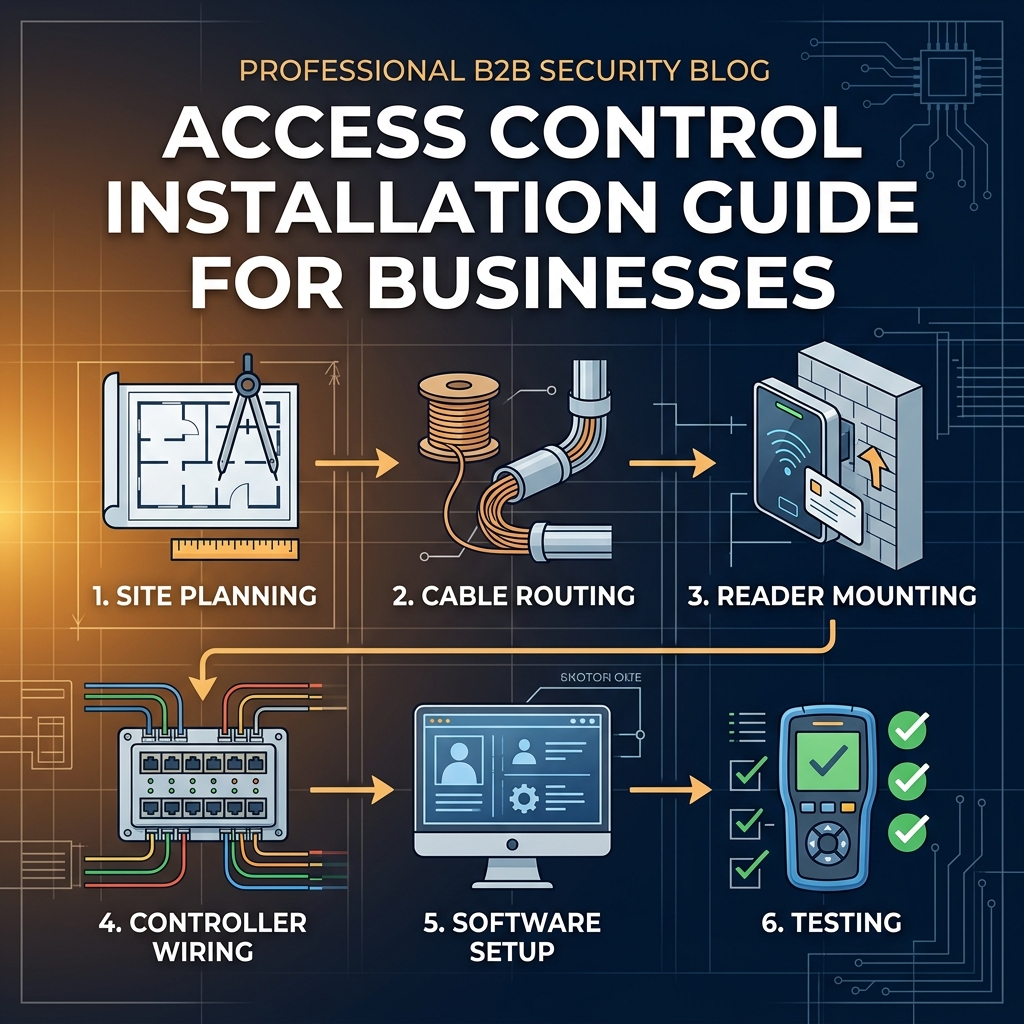
Start with a Site Assessment, Not a Product Catalogue
A proper access control installation begins with understanding your building — how many doors need control, what credential type suits each, and how the system should integrate with HR or CCTV — before any hardware is chosen.
Step 1: Map Every Door That Needs Control
List every entry point: main entrance, server room, finance department, storage areas, fire exits. For each, note expected traffic volume and sensitivity level, since this determines credential type and reader placement.
Step 2: Choose Credential Types Per Area
General areas typically suit card or mobile credentials for speed and cost-effectiveness. High-security areas — server rooms, cash handling, executive floors — usually warrant biometric readers for stronger identity verification.
Step 3: Plan Cabling and Power
Each door controller needs power (often via PoE) and a connection back to the access control panel or network. Planning these runs alongside any structured cabling work avoids costly retrofitting after walls and ceilings are finished.
Step 4: Select the Access Control Software Platform
The software manages credentials, access levels, time-zone rules, and reporting. Confirm it supports the integrations you need — HR system provisioning, CCTV triggering, and multi-site management if you have more than one location.
Step 5: Install Hardware and Wiring
Readers, controllers, electric strikes or magnetic locks, and request-to-exit devices are installed per door according to the design, with proper fail-safe or fail-secure configuration depending on fire safety requirements for each door.
Step 6: Configure Access Levels and Time Zones
Set up who can access which doors, and during what hours — general staff during business hours, specific roles with extended or 24/7 access where genuinely required.
Step 7: Test Every Door and Scenario
Verify each credential works at its intended door, confirm denied access is correctly logged, and test fire alarm integration to ensure doors release automatically during an emergency, as required by fire safety codes.
Step 8: Enrol Users and Train Staff
Enrol every employee's credential (card, fingerprint, or mobile), and brief staff and reception on visitor management procedures if included in the deployment.
Step 9: Document and Handover
Provide clear documentation of the system configuration, access levels, and admin procedures, along with training for whoever will manage day-to-day credential issuance and revocation internally.
A Note on Fire Safety Compliance
Access control must never compromise fire egress — doors on emergency exit routes need fail-safe configuration that releases automatically during a fire alarm, and this should be verified and documented as part of any installation, not assumed.
Getting It Right the First Time
For businesses across Ahmedabad, we follow this exact sequence on every access control project, sized to your specific building layout and security requirements rather than a generic template.
FAQs
Do you provide access control and biometric attendance systems?
Yes. We provide access control, door access, fingerprint attendance, and biometric attendance systems.
How can S.N Marketing help with Access Control Installation Guide for Businesses?
S.N Marketing can review your site requirements and recommend a practical solution for planning, installation, and support.
Do you provide service in Ahmedabad and nearby areas?
Yes. S.N Marketing serves Ahmedabad and nearby business areas including Gandhinagar, Sanand, Changodar, Naroda GIDC, Vatva GIDC, Odhav, SG Highway, Prahlad Nagar, and Satellite Ahmedabad.