
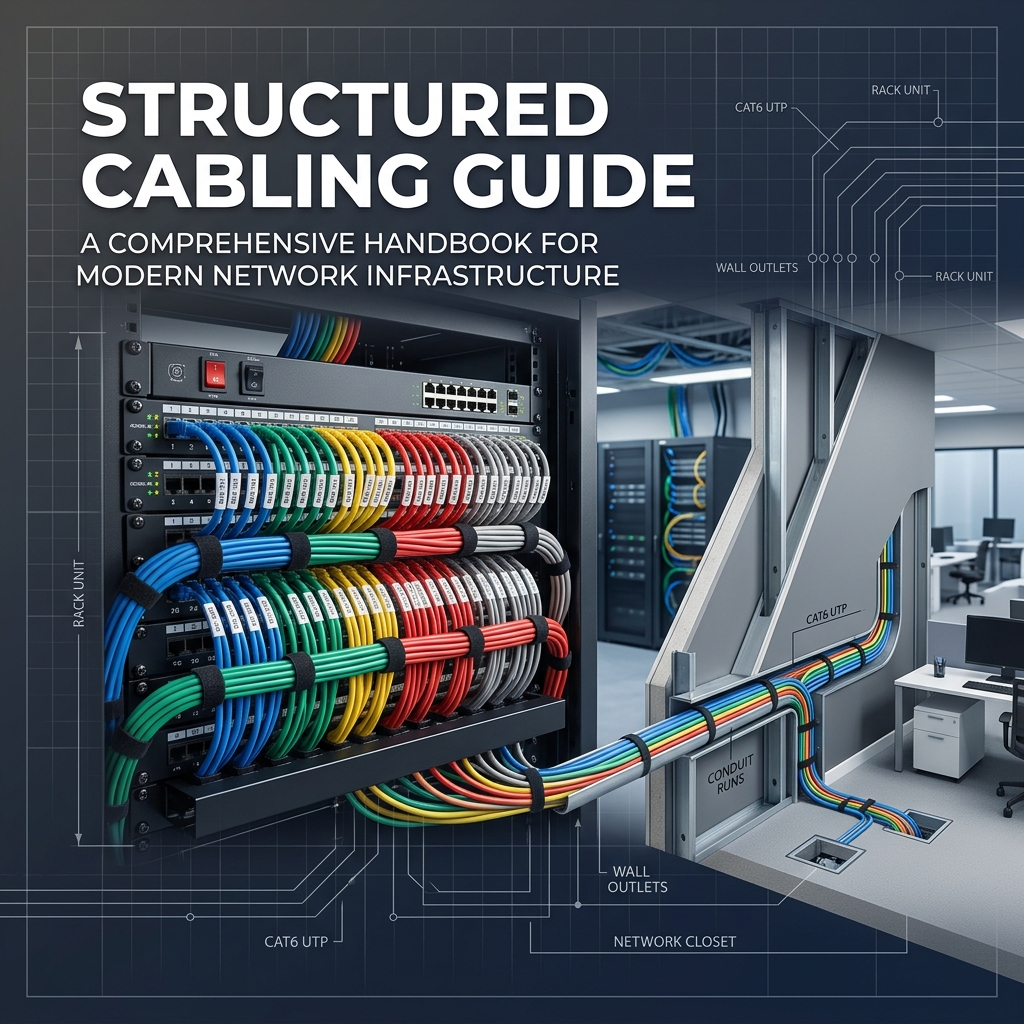
What is Structured Cabling?
Structured cabling is the standardised system of cables, patch panels, racks, and outlets that connects every network-dependent device in a building back to a central point. It is the physical layer underneath your network switches, Wi-Fi access points, IP phones, and cameras — the part nobody sees once the walls are closed up, but the part everything else depends on.
Cable Categories, Explained
- Cat5e — supports up to 1 Gigabit Ethernet, largely outdated for new installations.
- Cat6 — supports 1 Gigabit at full 100m, and 10 Gigabit up to around 55m.
- Cat6A — supports 10 Gigabit Ethernet over the full 100m run, the current recommended standard for new installations.
- Fibre optic (single-mode / multimode) — used for backbone links between floors or buildings, offering far greater bandwidth and distance than copper, unaffected by electrical interference.
For almost any new office installation today, Cat6A copper to the desk and fibre for backbone links is the standard recommendation — the cost premium over Cat6 is small, and the extra headroom avoids a costly re-cable in a few years.
The Standards That Matter
Structured cabling should follow recognised standards — TIA/EIA-568 and ISO/IEC 11801 — which define cable performance requirements, pathway and spacing rules, and labelling conventions. Following these standards is what makes a cabling system serviceable and warrantable, rather than a tangle that only the original installer can understand.
What a Proper Installation Includes
- Planned pathways — cable trays, conduit, and containment that keep runs organised and protected, not zip-tied to ceiling grids.
- Patch panels and racks — a structured termination point in the server/network room, with clear port labelling matching a floor plan document.
- Testing and certification — every cable run tested with a certified cable analyser (such as a Fluke DSX series tester) for wire map, length, attenuation, and crosstalk, with a report provided for every port.
- As-built documentation — a record of exactly what connects where, so future moves, adds, and changes do not require guesswork.
Why Cabling Quality Matters More Than It Seems
Network equipment — switches, access points, cameras — gets refreshed every 5-7 years. Cabling is expected to last 15-20 years, since replacing it usually means opening up walls and ceilings again. A poor-quality or badly documented cabling job creates years of intermittent, hard-to-diagnose faults that cost far more in troubleshooting time than the small upfront saving of cutting corners.
Planning a Structured Cabling Project
A good cabling design starts with more than today's device count — it accounts for future outlets in meeting rooms that may add video conferencing, areas that may need more Wi-Fi access points or cameras, and spare capacity in the server room. We design with headroom built in and document every run clearly, so the investment holds up for the building's next decade, not just its first year.
For new fit-outs, renovations, or expansions across Ahmedabad and Gujarat, structured cabling is the project step most often underestimated in the budget — and the one most worth getting right the first time.
FAQs
Do you provide structured cabling services?
Yes. We provide structured cabling, network cabling, racks, patch panels, testing, and labeling.
How can S.N Marketing help with Structured Cabling: Everything You Need to Know?
S.N Marketing can review your site requirements and recommend a practical solution for planning, installation, and support.
Do you provide service in Ahmedabad and nearby areas?
Yes. S.N Marketing serves Ahmedabad and nearby business areas including Gandhinagar, Sanand, Changodar, Naroda GIDC, Vatva GIDC, Odhav, SG Highway, Prahlad Nagar, and Satellite Ahmedabad.
Related Services and Locations
Structured Cabling
Future-ready Cat6A and fiber optic cabling infrastructure, professionally terminated and certified — forming the reliable backbone for your network, IP phones, cameras, and access control.
IT Infrastructure
Design, supply, and deploy server rooms, storage systems, and complete IT infrastructure — built to handle current workloads and scale gracefully as your business grows.