
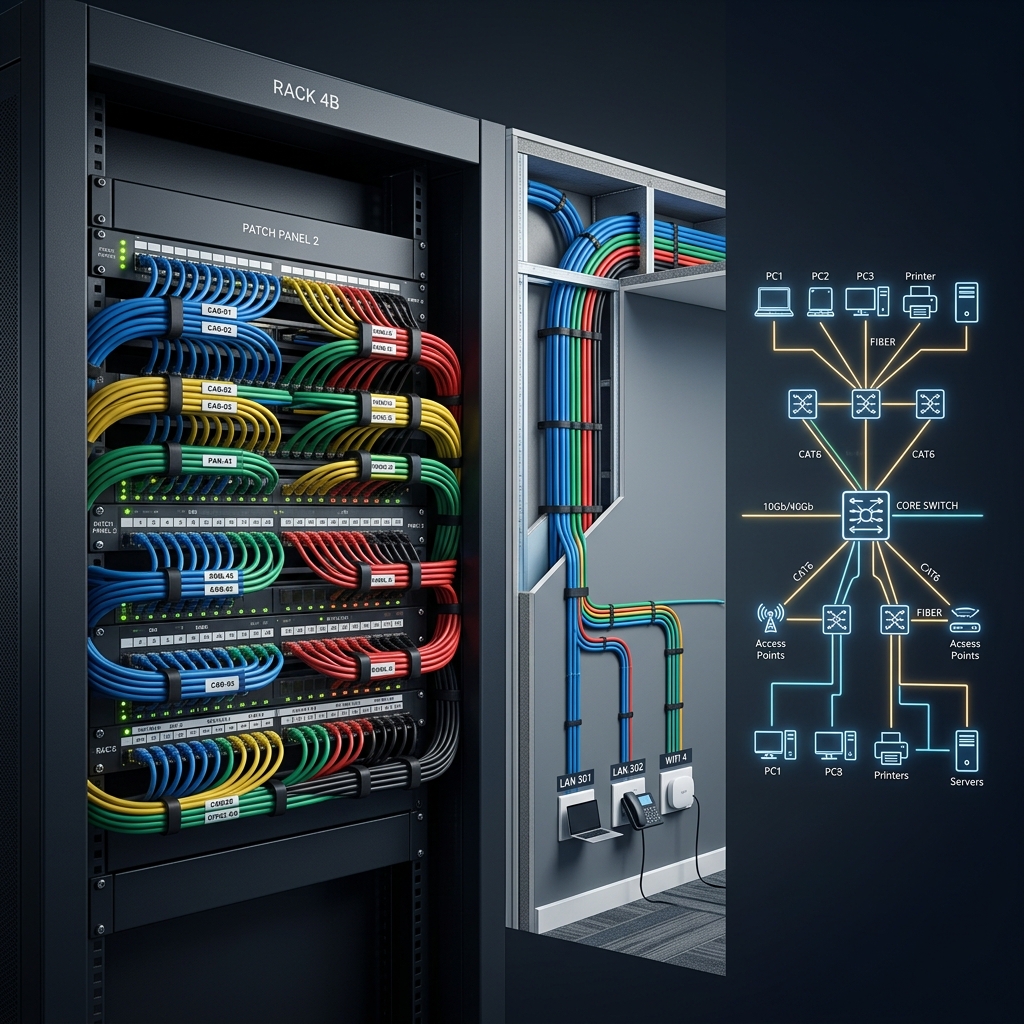
When businesses plan their IT budgets, structured cabling rarely gets the attention it deserves. It is hidden behind walls and under floors, it does not show up on a feature comparison sheet, and it is easy to assume "cable is cable." But structured cabling is the physical foundation that every other system in your building — Wi-Fi, telephony, CCTV, access control, and servers — depends on. Skimping on it creates problems that surface for years.
The Hidden Backbone of Every Office
Structured cabling refers to the standardised system of cables, patch panels, racks, and outlets that connect every network-dependent device in a building back to a central point. A well-designed structured cabling system is organised, labelled, and documented — meaning that years later, anyone can trace and troubleshoot a connection without guesswork.
Why Cabling Quality Matters More Than You Think
Network switches, Wi-Fi access points, IP phones, and cameras are typically refreshed every 5-7 years as technology improves. Cabling, on the other hand, is expected to last 15-20 years — it is far more disruptive and expensive to replace, since it usually means opening up walls and ceilings again. Investing in higher-grade cable (such as Cat6A instead of Cat5e) at installation time costs only marginally more but avoids a much larger cost of re-cabling when bandwidth requirements increase.
Future-Proofing with Cat6A and Fibre
Cat6A cabling supports 10 Gigabit Ethernet over the standard 100m run length, giving headroom for years of increasing bandwidth demand from Wi-Fi 6/6E access points, 4K video conferencing, and IP cameras. For backbone connections between floors or buildings, single-mode fibre provides essentially unlimited bandwidth headroom and is unaffected by electrical interference.
The Cost of Cutting Corners
We have walked into many offices where cabling was installed by whoever was cheapest at the time — unlabelled cables, inconsistent standards, and patch panels that do not match what is actually plugged in. The result: every new device installation or fault investigation takes hours longer than it should, because nobody can be sure which cable goes where. Multiply that inefficiency across the lifetime of a building and the "savings" from cheap cabling disappear quickly.
Planning a Structured Cabling Project
A proper structured cabling project starts with understanding not just today's device count, but where additional outlets might be needed in future — meeting rooms that may get video conferencing, areas that may need additional Wi-Fi access points or cameras, and server room growth. We design cabling layouts with spare capacity at each outlet location and document every run from outlet to patch panel with clear labelling on both ends.
The Bottom Line
Every wireless access point, every IP phone, every camera, and every server ultimately connects back to a cable. If that cable is poor quality, badly routed, or undocumented, it limits the performance and reliability of everything connected to it — no matter how good the equipment on either end is. Getting structured cabling right the first time is one of the highest-value, lowest-visibility investments a business can make in its IT infrastructure.
FAQs
Do you provide structured cabling services?
Yes. We provide structured cabling, network cabling, racks, patch panels, testing, and labeling.
How can S.N Marketing help with Why Structured Cabling is the Most Important Investment in IT?
S.N Marketing can review your site requirements and recommend a practical solution for planning, installation, and support.
Do you provide service in Ahmedabad and nearby areas?
Yes. S.N Marketing serves Ahmedabad and nearby business areas including Gandhinagar, Sanand, Changodar, Naroda GIDC, Vatva GIDC, Odhav, SG Highway, Prahlad Nagar, and Satellite Ahmedabad.