
The System Behind Every Other System
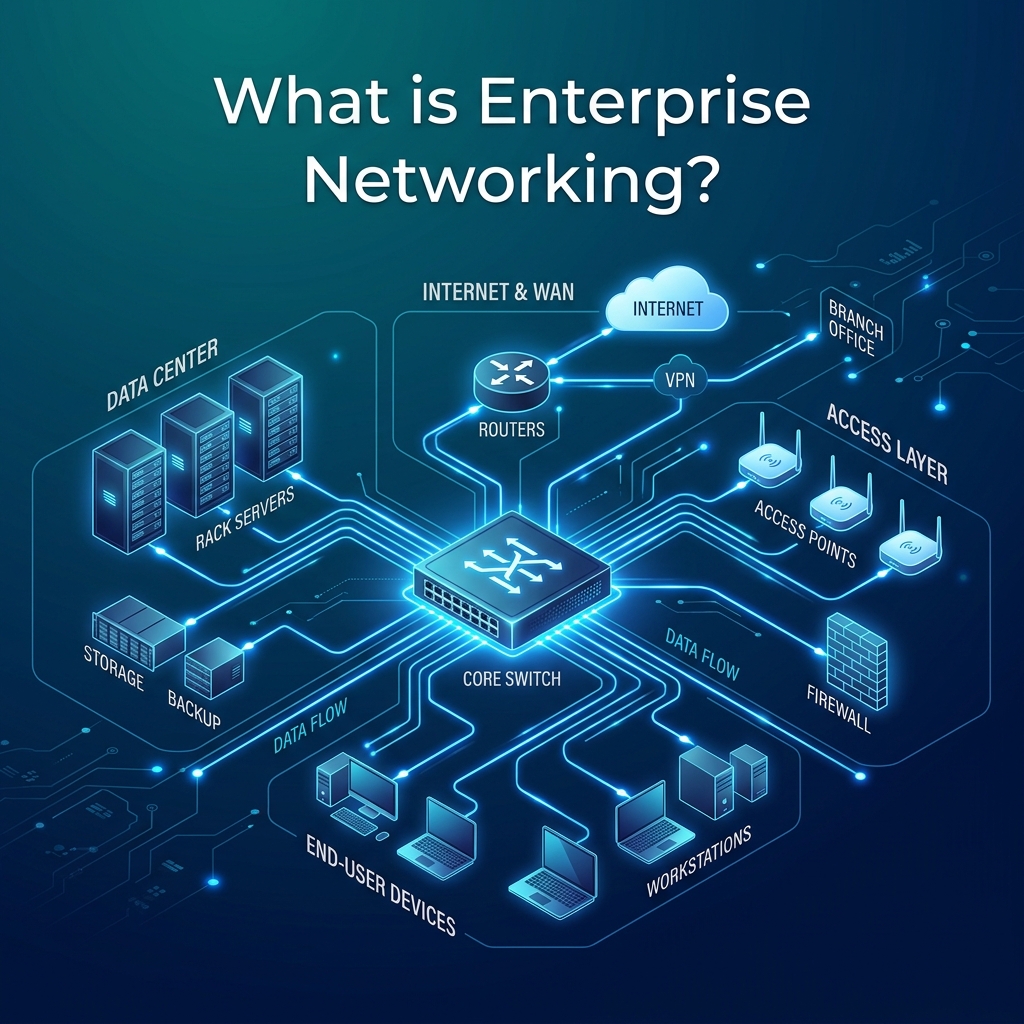
Enterprise networking is the design and deployment of the switches, routers, Wi-Fi, and security infrastructure that connects every device in your business — computers, phones, cameras, printers, and servers — and lets them communicate reliably and securely. Where a home network might have one router and a few devices, an enterprise network is engineered for dozens or hundreds of devices, multiple traffic types, and zero tolerance for downtime.
The Core Building Blocks
- Switches — connect wired devices within a location, forwarding traffic between them. Managed switches (as opposed to basic unmanaged ones) support VLANs, QoS, and monitoring — essential for any business beyond a handful of devices.
- Routers and firewalls — connect your internal network to the internet and other sites, while enforcing security policy at the boundary.
- Wireless access points — extend the network to mobile and wireless devices, ideally managed centrally rather than configured individually.
- Structured cabling — the physical Cat6/fibre backbone that every switch, access point, and device ultimately connects through.
Why "Just Plug It In" Does Not Scale
A flat, unmanaged network works fine for five people in one room. It breaks down once you add CCTV cameras, IP phones, guest Wi-Fi, and multiple departments — everything competing for the same bandwidth with no segmentation or prioritisation, and no visibility when something goes wrong.
Key Concepts in Enterprise Network Design
VLAN segmentation — splitting the network into logical groups (voice, data, CCTV, guest Wi-Fi) so that a compromised guest device cannot reach finance servers, and camera traffic does not compete with video calls.
QoS (Quality of Service) — prioritising latency-sensitive traffic like voice and video calls over less time-critical traffic like file downloads, so a large backup does not cause dropped calls.
Redundancy — designing so that a single failed switch, cable, or link does not take down the whole office, through link aggregation and redundant uplinks.
Centralised management — being able to see and control every switch and access point from one dashboard, rather than logging into each device individually to make a change or diagnose a fault.
How It All Connects Together
Enterprise networking is the foundation everything else runs on. Your IP PBX, CCTV system, Wi-Fi, and access control all depend on the network being properly designed — a badly cabled or unmanaged network causes intermittent faults across every one of those systems, even though the network itself is rarely the first thing blamed.
Planning a Network for Your Business
Whether you are fitting out a new office, adding a location, or dealing with a network that has grown organically without a plan, the starting point is the same: understand your device count, traffic types, and growth plans, then design switching, routing, and Wi-Fi to match — not the other way around. For businesses across Ahmedabad and Gujarat, we start every project with a site assessment before recommending hardware, so the network is sized for what you actually need rather than a generic template.
FAQs
Do you provide office networking solutions?
Yes. We provide office networking, LAN installation, Wi-Fi, switching, routing, and cabling support.
How can S.N Marketing help with What is Enterprise Networking??
S.N Marketing can review your site requirements and recommend a practical solution for planning, installation, and support.
Do you provide service in Ahmedabad and nearby areas?
Yes. S.N Marketing serves Ahmedabad and nearby business areas including Gandhinagar, Sanand, Changodar, Naroda GIDC, Vatva GIDC, Odhav, SG Highway, Prahlad Nagar, and Satellite Ahmedabad.