
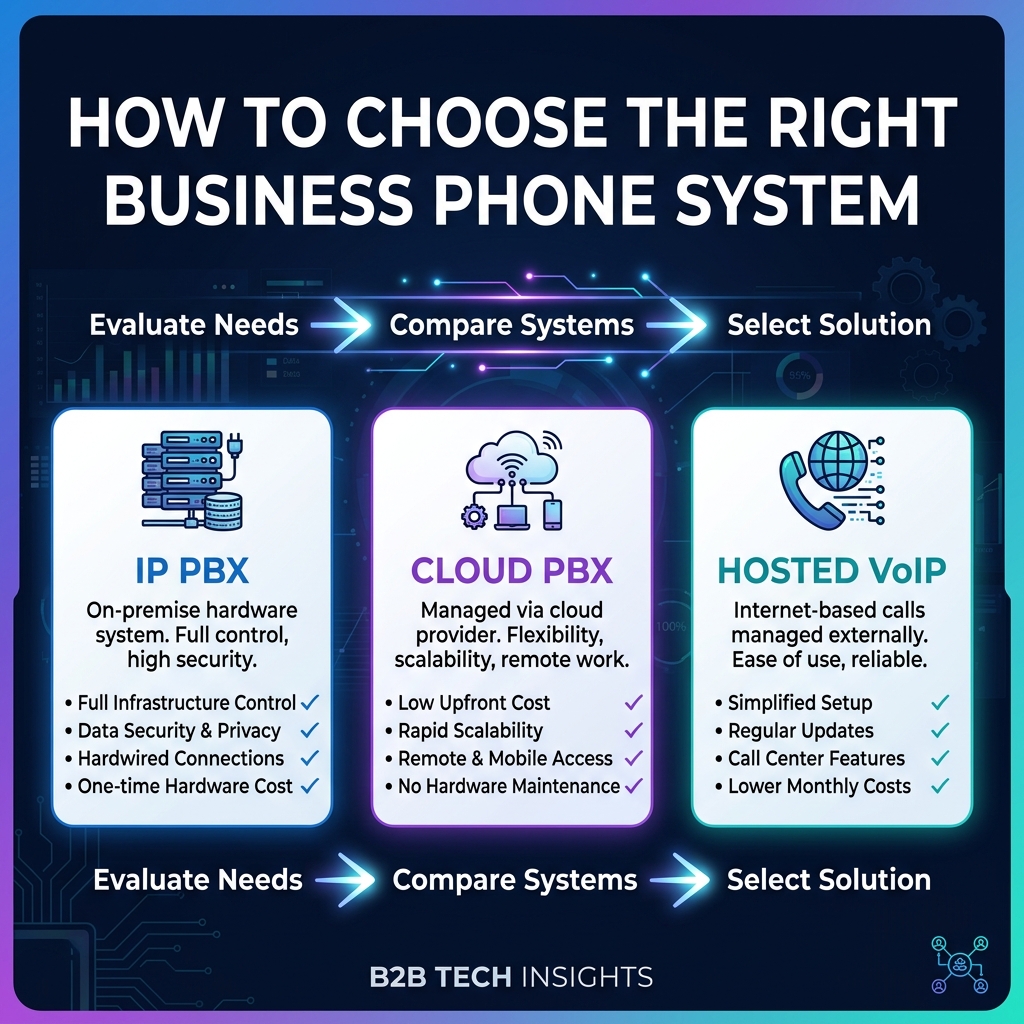
Start with Your Business, Not the Feature List
Every phone system vendor will show you a long feature list. The right starting point is not "which system has the most features" but "what does our business actually need" — team size, how many people work remotely, call volume, and whether you have branches to connect.
Question 1: How Many Extensions, and How Will That Change?
A 10-person office and a 200-person company need very different platforms. Beyond raw extension count, consider growth — a system that is cheap now but expensive to scale will cost more over three years than one slightly more expensive today with a clear growth path.
Question 2: Do You Need Remote and Mobile Support?
If any staff work from home, travel, or operate from multiple sites, prioritise a platform with a proper mobile softphone app that rings on the same extension as the desk phone — not just call forwarding to a personal mobile number, which breaks caller ID and call recording.
Question 3: On-Premise, Cloud, or Hybrid?
On-premise (like a Grandstream UCM appliance) gives you full control and no dependency on internet uptime for internal calls, at the cost of managing the hardware yourself.
Cloud-hosted removes hardware management entirely and scales easily, but depends on a reliable internet connection and a provider's uptime record.
Hybrid setups keep a local appliance for resilience while using cloud services for specific features — often the best of both for businesses that cannot tolerate any downtime.
Question 4: What Features Do You Actually Need Day-to-Day?
Common must-haves: auto-attendant/IVR for routing calls without a receptionist, call recording for training or compliance, voicemail-to-email so nothing gets missed, and hunt groups for departments like sales or support. Beyond these basics, features like CRM integration matter mainly for sales-heavy teams — do not pay for a tier of features you will not use.
Question 5: What is Your Realistic Budget — Including Ongoing Costs?
Compare total cost of ownership, not just upfront hardware price: SIP trunk costs, per-extension licensing, support contracts, and eventual hardware refresh. A cheaper system with expensive per-minute calling can cost more over two years than a pricier one with efficient SIP trunking.
Question 6: Which Brands Have a Track Record You Trust?
For IP PBX platforms and phones, Grandstream, Yealink, and Fanvil are widely deployed and well-supported across India, with strong parts availability and local expertise — an important practical consideration alongside features on a spec sheet.
Putting It Together
Most businesses land on one of two paths: an on-premise IP PBX for full control and predictable costs, or a cloud/hybrid platform for flexibility and lower upfront investment. Neither is universally "better" — the right choice depends on your specific answers to the questions above.
Getting a Recommendation Specific to Your Business
Rather than choosing based on a spec sheet alone, we review your current call patterns, growth plans, and remote work needs, then recommend a specific platform and configuration — for businesses across Ahmedabad and Gujarat, this consultation is free and usually takes less than an hour to identify the right fit.
FAQs
Do you provide IP PBX installation in Ahmedabad?
Yes. We provide IP PBX planning, SIP phone setup, configuration, and support for Ahmedabad businesses.
How can S.N Marketing help with How to Choose the Right Business Phone System?
S.N Marketing can review your site requirements and recommend a practical solution for planning, installation, and support.
Do you provide service in Ahmedabad and nearby areas?
Yes. S.N Marketing serves Ahmedabad and nearby business areas including Gandhinagar, Sanand, Changodar, Naroda GIDC, Vatva GIDC, Odhav, SG Highway, Prahlad Nagar, and Satellite Ahmedabad.