
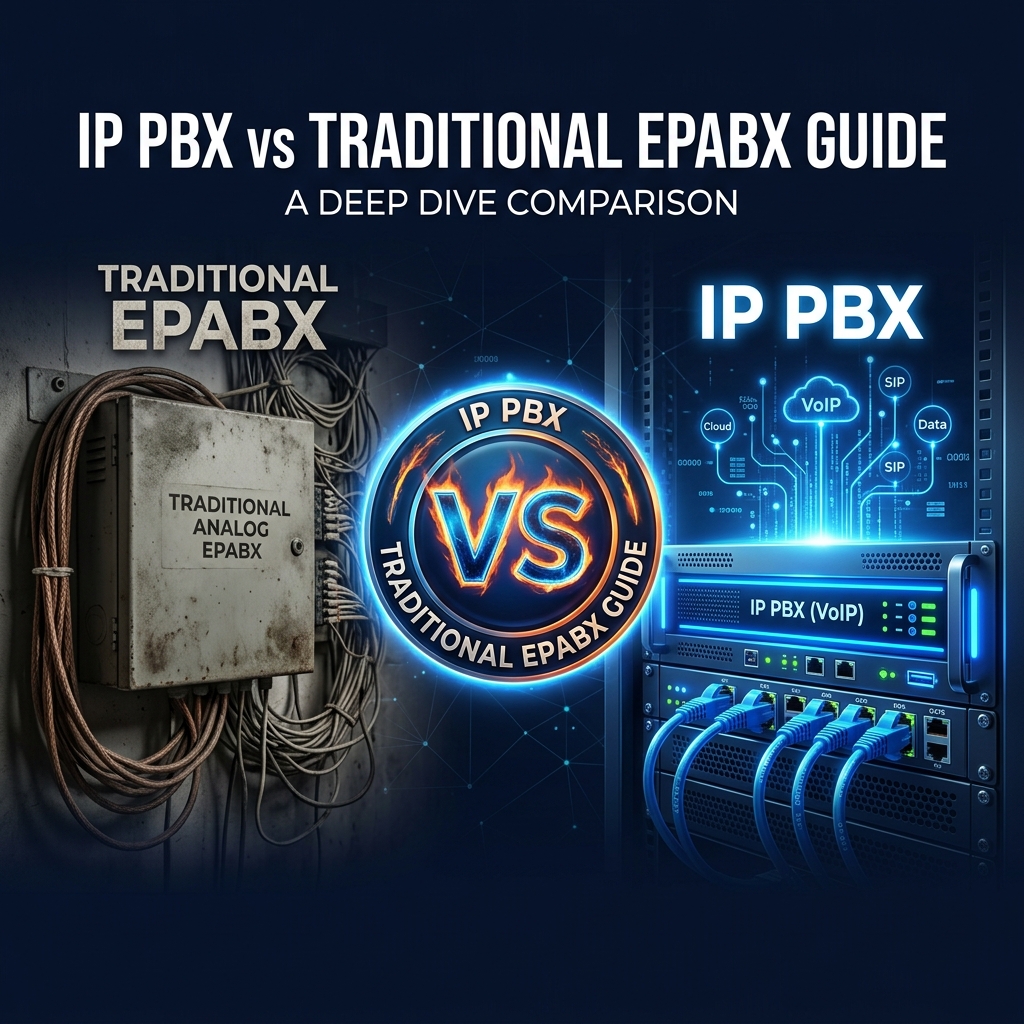
Two Approaches to the Same Job
Both IP PBX and traditional EPABX exist to do one thing: connect internal extensions and route calls to the outside world. Where they differ is in the underlying technology, and that difference has real consequences for cost, flexibility, and how your business can grow.
Traditional EPABX
A traditional (analog or digital) EPABX is a dedicated hardware switchboard. Every extension is wired back to the EPABX cabinet on its own copper pair. Outside lines connect via analog trunks or ISDN/PRI circuits from the telecom provider. It is reliable, well understood, and does not depend on your data network — but it is inflexible and expensive to expand.
IP PBX
An IP PBX uses SIP over your existing Ethernet/Wi-Fi network. Extensions are software registrations, not physical wiring runs. Outside connectivity comes via a SIP trunk, which typically runs over the same internet connection you already have.
Comparing the Two Directly
Cabling: EPABX needs a dedicated telephone cable to every extension. IP PBX reuses your existing structured cabling and PoE switches — no separate wiring system.
Cost to add an extension: EPABX often means a new expansion card once ports run out. IP PBX means a software license and a phone — no cabinet upgrade.
Call costs: EPABX relies on PSTN/ISDN lines billed per call. IP PBX uses SIP trunks, and inter-branch or app-to-app calls run over data at no extra cost.
Remote work: EPABX extensions are fixed to a desk. IP PBX extensions follow the user via a mobile or desktop softphone.
Features: EPABX feature sets are fixed by the hardware generation you bought. IP PBX platforms add features like CRM integration and call analytics through software updates.
Reliability without internet: EPABX keeps working even if your internet is down, since it does not depend on it. IP PBX needs a working network — though a local PSTN or cellular failover line handles this for most deployments.
Which One Should You Choose?
If you already have a functioning EPABX and are not planning to grow, extending it may be the path of least resistance in the short term. But for any new office, an expansion, or a business that wants lower call costs and mobility, IP PBX is now the standard recommendation — including for offices across Ahmedabad and Gujarat replacing decades-old EPABX cabinets that are increasingly hard to source spare parts for.
A Practical Migration Path
Most businesses do not need to rip out their EPABX overnight. We typically run the new IP PBX in parallel, migrate departments in phases, and decommission the EPABX once every extension and feature has been verified — minimising disruption to day-to-day operations.
FAQs
Do you provide IP PBX installation in Ahmedabad?
Yes. We provide IP PBX planning, SIP phone setup, configuration, and support for Ahmedabad businesses.
How can S.N Marketing help with IP PBX vs Traditional EPABX?
S.N Marketing can review your site requirements and recommend a practical solution for planning, installation, and support.
Do you provide service in Ahmedabad and nearby areas?
Yes. S.N Marketing serves Ahmedabad and nearby business areas including Gandhinagar, Sanand, Changodar, Naroda GIDC, Vatva GIDC, Odhav, SG Highway, Prahlad Nagar, and Satellite Ahmedabad.
Related Services and Locations
IP PBX Solutions
Replace legacy EPABX with scalable, feature-rich SIP-based telephony that connects your offices, remote workers, and call centres on one unified system.
Structured Cabling
Future-ready Cat6A and fiber optic cabling infrastructure, professionally terminated and certified — forming the reliable backbone for your network, IP phones, cameras, and access control.