
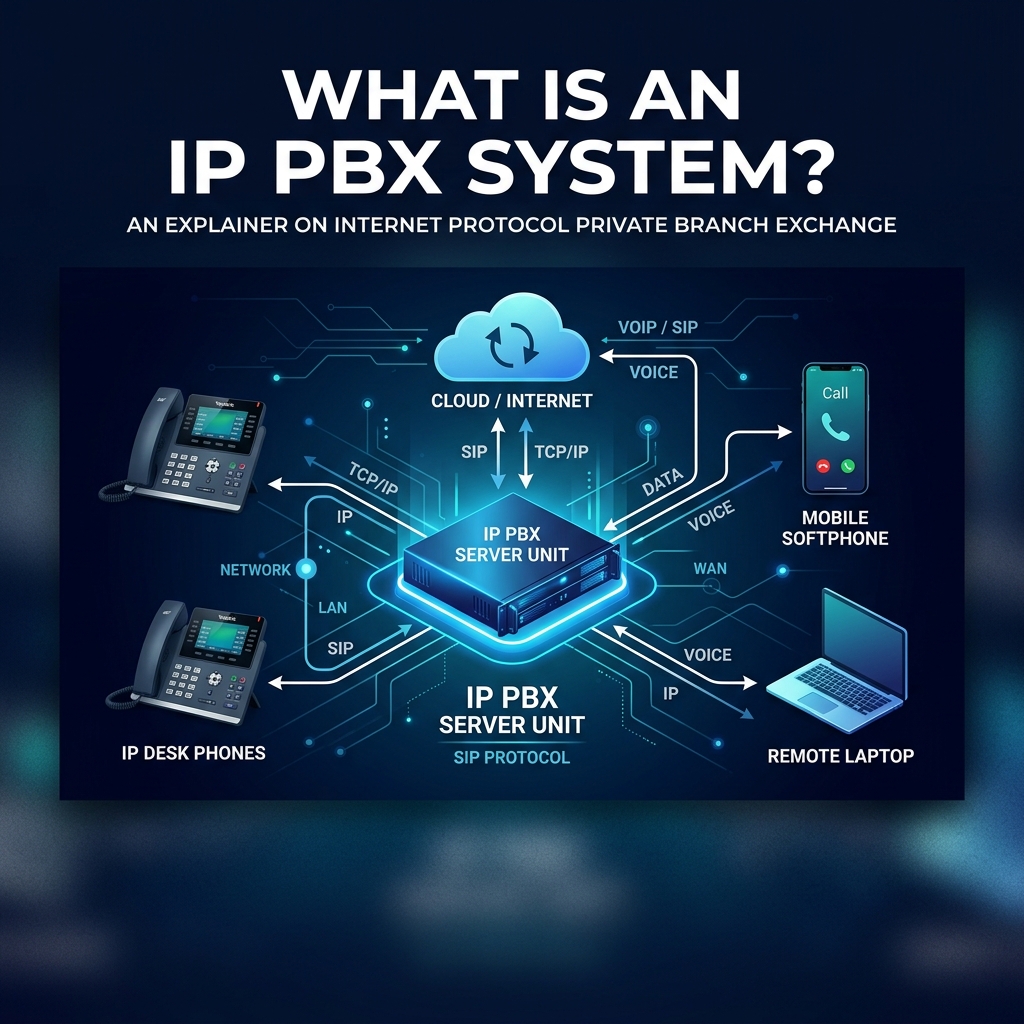
What Does IP PBX Actually Mean?
IP PBX stands for Internet Protocol Private Branch Exchange. In simple terms, it is a phone system for a business that routes calls over a data network (your LAN or the internet) instead of dedicated copper telephone lines. Every extension in your office — desk phones, mobile softphone apps, laptop apps — connects to the IP PBX using the SIP (Session Initiation Protocol) standard.
If a traditional EPABX is like a physical switchboard wired with copper, an IP PBX is software (running on an appliance, a server, or in the cloud) that does the same job using the network you already have.
How Does an IP PBX Actually Route a Call?
- Registration — Every SIP phone or app registers itself with the IP PBX over the network, similar to how a device joins Wi-Fi.
- Dialling — When someone dials an extension or an outside number, the request goes to the IP PBX as a SIP signal.
- Call routing — The IP PBX checks its dial plan: is this an internal extension, a hunt group, an IVR menu, or an outside call that needs to go via a SIP trunk?
- Media path — Once the call is set up, the actual voice audio (RTP media) flows between the two endpoints, often directly, keeping call quality high and latency low.
- Features applied — Call recording, voicemail-to-email, call queuing, and CRM screen-pops all happen at this layer, without any extra hardware per feature.
The Core Components
- IP PBX appliance or software — hardware like the Grandstream UCM series, or a software PBX such as 3CX, running on-premise or in the cloud.
- SIP trunk — the connection to the outside telephone network (PSTN), replacing traditional analog lines, usually provided by a telecom carrier.
- SIP phones or softphones — desk phones (Yealink, Fanvil, Grandstream) or mobile/desktop apps that register as extensions.
- Your data network — switches, PoE ports, and adequate bandwidth, since voice now shares the same network as your computers and Wi-Fi.
Why Businesses Are Moving to IP PBX
- Lower running costs — inter-branch calls run over the data network at no per-minute cost, and SIP trunks are typically cheaper than equivalent analog lines.
- Remote-ready — an employee's extension follows them home or to a client site via a softphone app, without forwarding rules or a second number.
- Feature-rich out of the box — auto-attendants, call recording, and voicemail-to-email are standard, not expensive add-ons.
- Easy to scale — adding an extension is a software license and a phone, not new cabling or hardware modules.
Is IP PBX Right for Every Business?
For most offices with 10 or more employees, yes — the cost savings on SIP trunking alone often justify the switch within a year or two. The main requirement is a stable network with enough bandwidth and, ideally, PoE switches to power the phones. For businesses in Ahmedabad and across Gujarat still running legacy EPABX systems, migrating to IP PBX is usually a phased, low-disruption project, often completed over a weekend with parallel running to avoid downtime.
If you are evaluating whether IP PBX makes sense for your business, our engineers can review your current call patterns and recommend the right platform and trunk configuration.
FAQs
Do you provide IP PBX installation in Ahmedabad?
Yes. We provide IP PBX planning, SIP phone setup, configuration, and support for Ahmedabad businesses.
How can S.N Marketing help with What is an IP PBX System and How Does It Work??
S.N Marketing can review your site requirements and recommend a practical solution for planning, installation, and support.
Do you provide service in Ahmedabad and nearby areas?
Yes. S.N Marketing serves Ahmedabad and nearby business areas including Gandhinagar, Sanand, Changodar, Naroda GIDC, Vatva GIDC, Odhav, SG Highway, Prahlad Nagar, and Satellite Ahmedabad.