
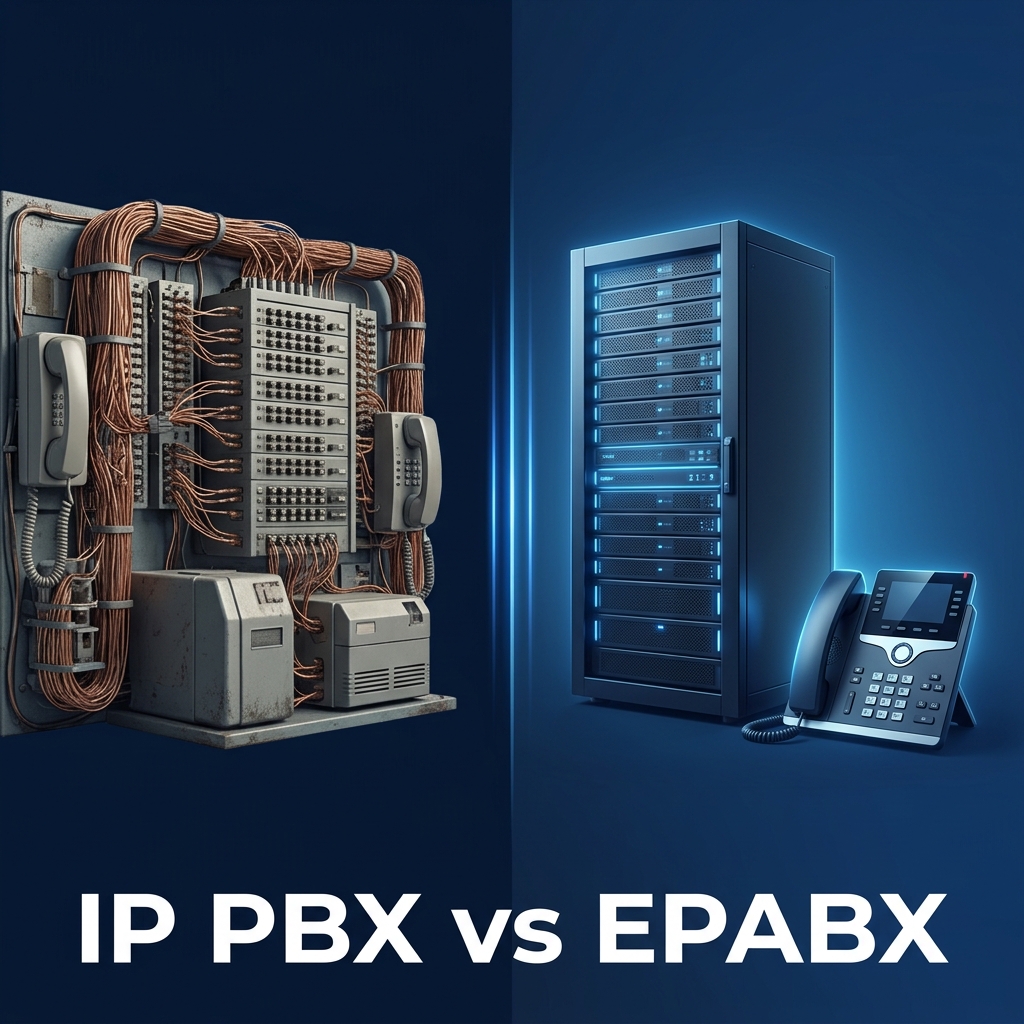
What is an EPABX?
An Electronic Private Automatic Branch Exchange (EPABX) is a traditional telephone exchange that routes calls between extensions within an office and connects to the outside world via analog or ISDN trunk lines. EPABX systems are reliable and well understood, but they are built around fixed hardware, proprietary handsets, and copper wiring — which makes them expensive to expand and difficult to integrate with modern software.
What is an IP PBX?
An IP PBX (Internet Protocol Private Branch Exchange) routes calls as data over your existing network using the SIP (Session Initiation Protocol) standard. Extensions can be physical IP phones, mobile softphone apps, or browser-based clients, and the system connects to the outside world via SIP trunks instead of physical phone lines.
Key Differences That Matter
- Cost of expansion — Adding a new extension on an EPABX often means running new copper cable and configuring proprietary hardware. On an IP PBX, a new extension is a software configuration that can use your existing network cabling.
- Remote and mobile working — IP PBX extensions can be used from anywhere with an internet connection via softphone apps, so staff can answer their office number from home or on the move. EPABX extensions are tied to a physical location.
- Features included — Auto-attendants, call recording, voicemail-to-email, hunt groups, and CRM integrations are standard on most IP PBX platforms. On EPABX systems, many of these require costly add-on cards or are simply unavailable.
- Maintenance and support — EPABX hardware is increasingly difficult to source spares for as manufacturers discontinue legacy models. IP PBX platforms run on standard servers and are actively updated by vendors.
- Call costs — SIP trunks are typically cheaper than traditional PRI/ISDN lines, and inter-office calls between IP PBX sites can be free over the data network.
When Does EPABX Still Make Sense?
If your existing EPABX is working reliably, your call volumes are stable, and you have no plans for remote work, multi-site operations, or software integrations, there may be little urgency to switch. However, if your EPABX vendor has discontinued support, or you are planning office expansion, a new branch, or a hybrid work policy, the case for IP PBX becomes much stronger.
Making the Switch
A well-planned migration does not have to mean downtime. At S.N Marketing, we typically run the new IP PBX in parallel with the existing system, port numbers across in a controlled cutover window (often overnight), and provide hands-on training for front-desk and reception staff who rely on call transfer and hold features daily.
If you are evaluating your options, our engineers can review your current setup, call volumes, and growth plans, and recommend whether an IP PBX migration — full or phased — makes sense for your business.
FAQs
Do you provide IP PBX installation in Ahmedabad?
Yes. We provide IP PBX planning, SIP phone setup, configuration, and support for Ahmedabad businesses.
How can S.N Marketing help with IP PBX vs Traditional EPABX: What's Right for Your Business in 2025??
S.N Marketing can review your site requirements and recommend a practical solution for planning, installation, and support.
Do you provide service in Ahmedabad and nearby areas?
Yes. S.N Marketing serves Ahmedabad and nearby business areas including Gandhinagar, Sanand, Changodar, Naroda GIDC, Vatva GIDC, Odhav, SG Highway, Prahlad Nagar, and Satellite Ahmedabad.